Wednesday, April 13, 2022

Service Bulletin 00053: I had my head in my tail cone!

Recently, for several RV-12s, cracks in the skin of the tail cone have been discovered at the lowermost point where each of the three bulkheads attaches to the skin.  A structural member with a J-shaped cross section about an inch tall runs the length of the bottom of the tail cone but is discontinuous at the bulkheads, leaving the skin itself as the load path.  There are eight more of these stringers arrayed around the circumference and running the length of the tail cone, but each of them is a single piece of shaped aluminum (no discontinuity).  The Mothership ran an FEA analysis and decided that stiffening brackets needed to be riveted through the front and back of each bulkhead (except the aft most, which gets only the front) and to the skin, providing a load path and relieving the skin itself of some of its burden.  Sounds easy, and it would be if it were being done as the tail cone was originally built.  For an airplane with the tail cone already attached (with hundreds of rivets) to the forward portion of the fuselage, it's a massive problem, far and away the most onerous Service Bulletin to come out in the entire build.  A Service Bulletin for an airplane licensed in the Experimental category is roughly equivalent to an Airworthiness Directive for a store-bought airplane.  The picture shows the completed installation so you can get an idea what I'm describing.  If you click the pic and then expand it you can see the forward brackets installed at the bottom center of each bulkhead.  The aft brackets are hidden.


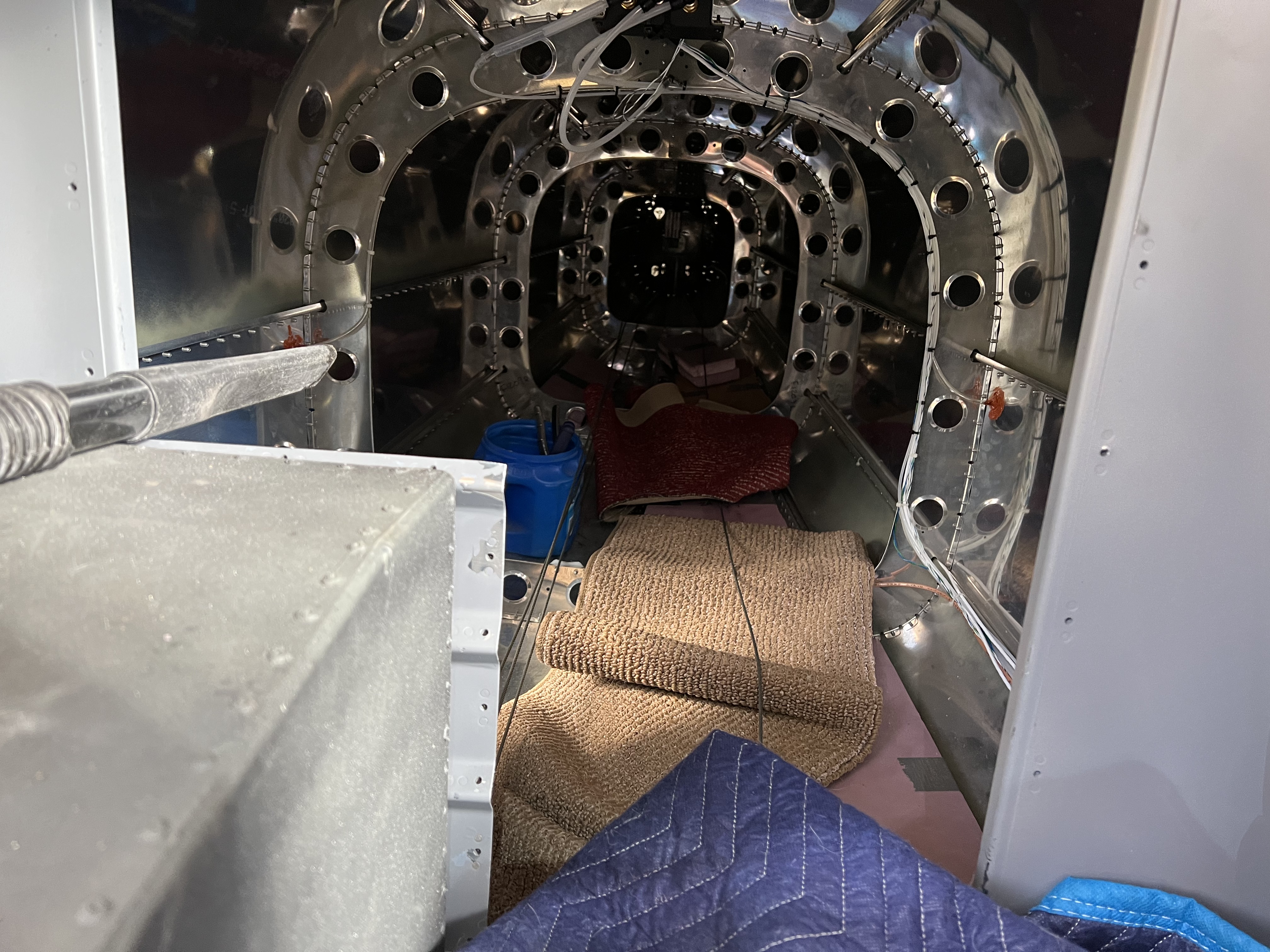
First off, the six rivets joining the skin to the stringers (remember, it's discontinuous) fore and aft of the bulkheads must be drilled out.  This is trivial since it can be done from outside the tail cone.  Then the three rivets joining the two halves of each bulkhead must be drilled out.  This, of course, must be done from inside the tail cone.  The five stiffening brackets are then clecoed in place (front and back except for the aft most bulkhead which gets only the front) and riveted.  This means a human being must somehow go inside the tail cone for its entire length and do all this.  The pic makes the inside of the tail cone look much bigger than it is.  Trust me.  Van's suggested, somewhat tongue-in-cheek I suppose, that enlisting the help of a smallish teenager might be appropriate.  The problem is that whoever goes back there has to have the skill to drill out the rivets without enlarging the holes and then set the new rivets.  I can't imagine trusting someone else to do this, especially someone who hasn't built an aluminum airplane before.


The instructions said to cut pieces of 5/16th plywood to place in each bay to support the load without damaging the skin.  I used pieces of 1-inch-thick foam insulation from the aviation aisle at Home Depot, doubled to give a stiff but soft place to put my knees and elbows.  I also used moving blankets and bits of carpet (which gave me carpet burns on my elbows, reminding me of my highschool years).  All this stuff and I were restricted to the left side of the tail cone because the tensioned elevator cables are on the right.

The third pic shows my work space (crawl space?) with all this stuff in place.  A bit of bad luck, completely by chance, manifested itself when I realized that when I built the tail cone I put the shop heads on the rivets forward rather than aft.  This meant that the rivets had to be drilled out from the aft side of the bulkheads.  When I made it to the aft-most bulkhead, I discovered that my head wouldn't fit past the stabilator counterweight, meaning I couldn't see to drill out the rivets, necessitating the use of a mirror, all while painfully perched on my elbows and

knees.  The gas tank on the lower left made it hard to get in and out, which had to happen several times per bulkhead.  If I had had an assistant to insert clecos from outside, the whole process would have been much easier.

I hear other builders saying this seems impossible.  The moral of this post is this:  If an old gimp like me can do this, any builder can.


Coming soon to a browser near you:  The Engine.


Wednesday, January 5, 2022

Page 25A-04 Bonding the rear Plexiglas window to the aluminum

Back in September of the miserable year that was 2020 (and now that I've seen the entirety of 2021 I think it was worse) I described the expensive and tedious process of fitting and drilling the rear window. It was expensive because I had to buy another window.  The last task in the window installation was to bond using ProSeal (my 431st favorite substance) the PlexiGlas to the aluminum turtle deck.  In order to allow easier access, I put this permanent attachment off until everything aft of the seat backs

(ADAHRS, ELT and fuel tank) had been installed.  The forward edge of the window screws into the previously drilled and tapped holes in the roll bar, and this attachment is done first.  The aft and side portions of the window attach with screws and nuts to the aluminum turtle deck through previously drilled holes.  All this is done before bonding with all fasteners loosely attached.

ProSeal has a six month shelf life and I had bought this batch to seal the fuel tank back before the move from NC approximately two years ago.  I would definitely not use expired stuff on the tank, but for this application I simply mixed up and observed a test batch to make sure that it would set up.  I'm never confident with this stuff.  It has to be mixed 10:1 by weight, ProSeal to catalyzer using a postal scale.  It took longer to set up, partly owing to low temperatures, but worked.

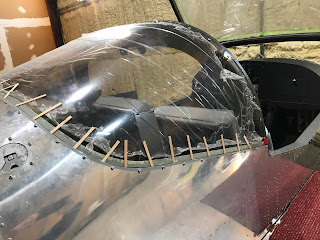
As shown in the first picture, I used ice cream sticks to create a space for the ProSeal between the aluminum and the PlexiGlas.  A gob of catalyzed ProSeal about the volume of two golf balls was put into a zip lock baggie, a corner was cut off the baggie about 1/16th inch, and I squeezed the stuff into the gap as if I were decorating a cake, removing spacers as I went.  All fasteners were then given their final low torque and the squeezed-out ProSeal was scraped up using the rounded end on the smallest ice cream stick.  These words don't come close to conveying how messy this process was.  If ProSeal gets onto any fabric, it's there forever.  I have a particular pair of pants, shirt, socks, etc that I wear for any operation involving ProSeal.


A close inspection of the first picture will reveal tape following the contour of the aluminum and tape spaced 1/16th inch from the aluminum on the PlexiGlas.  This, in theory,  prevents ProSeal from getting on anything it shouldn't be on.  The problem with this is that cutouts must be made in the tape on the aluminum around every screw head, leaving little room for error.  Acetone can be used to clean up errant ProSeal from aluminum.  The ProSeal simply can't be allowed onto the Plexi outside the 1/16th inch strip.  This process was not fun and I was not pleased with the result.


The real problem, or so I thought, was that I'd foolishly applied the tape to the Plexi back in NC two years ago.  As a result, when I attempted to remove the tape the adhesive remained on the Plexi while the tape backing peeled off.  A search ensued for a chemical which would remove the adhesive while not damaging the Plexi.  Opinions on the forums and internet in general were all over the map, often contradicting one another.  With fear and trepidation I settled on naphtha and applied it to the offending adhesive.  Worked like a charm.

Next up:


Wednesday, November 17, 2021

Instrument panel - autopilot knobs panel cutouts plus vinyl application

The first task required for prepping the instrument panel to actually receive instruments is to cut the holes for the two autopilot knobs panels.  The autopilot can be used without the panel, of course, but the common wisdom says that using the touchscreen on the Dynon Skyview HDX for all inputs is less than ideal.  It's much easier and more fun with actual knobs (especially in turbulence, I'm told).


Van's supplies a metal drill guide for locating and drilling the corners of the cutouts.  The rest involves cutting between the holes and filing the edges smooth.  The build manual suggests taping as shown to mark where the cuts go.  After drilling the 24 corner holes and mounting holes I used a straight edge and scribe to mark where the cuts would go but I suppose the tape makes it more visible.


The Van's site shows a part number for the center panel with the cutouts already there, but a call to them revealed that they never actually made it available.  

All the other cutouts and holes seen in the pic at right are already there.

I had received the right panel long ago and 1640 miles away when I was still in my ancestral stomping grounds of North Carolina.  The plans then called for all the holes in that panel to be counter sunk, which I did.  After making the decision to use faux carbon fiber vinyl wrap on the panel, I regretted that.  Turned out it didn't matter.  I have used black oxide button-head machine screws for the entire panel and, as the picture shows, they work just fine, even with counter-sunk holes.  The vinyl is 3M 2080 and, in my humble opinion, looks great.  I was so pleased with the wrap that I've decided to wrap the whole airplane.  Seriously.

If you click the pic to enlarge it, I think you'll agree.  The hardest part was getting the "weave" to line up at the panel edges, especially for the map box door.  I did the center and right panel with the aluminum pieces lying flat on a table.  For reasons I can't remember, I applied the wrap to the left panel after it was mounted in the airplane, resulting in a weave mismatch between the lower part of the left and center panels (visible in the next pic).  If I were doing it again I could do it perfectly (once again recalling the sage advice of those who have gone before: Perfection is the enemy of actually flying your airplane.


All instrument holes were cut out with an Exacto knife after the vinyl was applied, leaving about 1/2 inch extra to be wrapped around the hole edges.  A diagonal cut was made at each interior corner to allow wrapping.  All the screw holes were opened by spinning by hand a slightly larger bit in the hole.  The button-head screws conceal imperfections.


Sunday, June 6, 2021

Page 34-13: Making the fiberglass canopy skirt

Sometimes a made-up German phrase is required to adequately describe something: Yes, for the third time in the build, we have another Klöster Föken.

As I alluded to in the last post, I've dreaded the canopy fiberglass more than any other part of the build.  That dread was not misplaced.  The result of this section should be a fiberglass skirt attached to the Plexiglas canopy bubble and the aluminum pieces which are already attached to the bubble as described in the previous section.  The this section starts with two blocks of foam which must be shaped to conform to the curvature of the surrounding aluminum.  This is all done by eyeball.


The blocks must first be trimmed and drilled with a hole saw for access to the canopy pivot bolts which are already in place.  On the first drilling operation I managed to break off part of the foam, requiring that I fabricate out of scrap a new "nose" piece and epoxy it on (clearly seen on the left piece in the pic).


This is then epoxied to the existing aluminum structure and trimmed to match the existing curvature.  After shaping the first one entirely with 80-grit sandpaper attached to a block, I wised up and did the rough cut with a hack saw blade.


Shown below the piece being shaped is some scrap foam I inserted, later to be removed, to support the fiberglass which will hang down about 1/8th inch below the bottom of the temporary piece.


The pic at left shows the foam glued in place and shaped to match the surrounding curvature.  Three pieces of temporary foam are shown below the glued piece.  

Duct tape is applied everywhere the fiberglass skirt will contact the aluminum but should not adhere to it.  Packing tape is placed over the duct tape and a release agent is liberally smeared on this combo to allow the fiberglass to be removed.  I used Carnauba car wax.  Worked great.


The fiberglass cloth pieces will be cut to shape and applied to everything inside the duct tape and the red electrical tape which is applied to the Plexiglas and marks the bottom edge of the part of the Plexiglas which is to remain clear.  I used red electrical tape to contrast with the coming epoxy which I dyed black so it would look better from inside the airplane (thanks Dog Aviation!).  The green tape seen just below the red is inside the Plexiglas.


The pic at left clearly shows the aluminum piece shaped and installed in the previous post.  The coming fiberglass/epoxy will adhere itself to this, the foam block and the Plexiglas canopy below the red tape.  Because of the release agent (seen in the can sitting on the nose), the fiberglas/epoxy will lie against but not adhere to the aluminum covered by the duct tape.  Got it?

Now the bad part starts.


Five paper templates are supplied for cutting pieces of fiberglass cloth for each side, ten in all.  If you expand the picture at right you'll see cut lines on the paper.  The idea is to cut the outer piece of cloth, trim the paper template at the next inboard line, cut the cloth, repeat.

All cutting is done with a rotary knife against a smooth piece of plywood.


The fiberglass strips which bridge across between the side pieces are rectangular and of a specified width and length, eight pieces in all.

So far, so good.  Now the first piece of cloth, which was so carefully cut to shape, is to be placed on a piece of plastic cooking wrap and wetted out with epoxy. I used West System epoxy.  Some experts (not being sarcastic here -- these people truly are experts) advise against using the pumps to dispense the epoxy in proper proportions and suggest that weighing the epoxy is best.  Using a postal scale for this caused me to have little confidence in this method, probably because of poor technique on my part. The pumps were quick, easy, and seemed to work perfectly.  I love the pumps.


After carefully cutting the first, largest piece of cloth to shape I transferred it to the cooking wrap, whereupon its shape immediately changed from what it should have been into something that resembled the state of Texas.  No amount of tugging would transform it back into the shape of the template.  I did the best I could, brushed on the epoxy, squeegeed out all the excess and transferred it to the canopy.  I had marked the area it was supposed to cover and it was nowhere close.  Each subsequent piece of cloth is placed dry on the previous, still tacky piece of cloth and wetted out using a brush.  The picture at right shows all five pieces of cloth/epoxy in place.  I showed the right side because, as bad as it looks, it was way better than the left side (the first one I did).  The strips bridging left and right were then done in a particular order and position. 


Then the fun begins.  Supposedly, the good thing about fiberglass is that if you (word redacted due to the family nature of this blog) it up, you simply sand away the bad part and re-do it.  This was my saving grace.  If you look at EweTube (they're a bunch of sheep) videos showing this process it all comes out near perfect after the first layup.  Mine came out looking like the surface of the moon.  Small fiberglass patches can be glassed into the low spots and high spots can be sanded down.  Every time you glass something it needs at least 24 hours to cure before sanding, depending on the temperature in the hangar.  This takes a while.  Here in Colorado while I was doing the fiberglassing the OAT was sometimes below 20 F.  My gas heater could only get the temperature in the hangar up to about 52 F on the coldest days.

The radius of curvature for the intersection of the Plexiglas and the aluminum is supposed to be 2 inches.  I discovered that the O.D. of a 3-inch PVC coupling is 4 inches.  Perfect.  


After quite a few iterations of glassing and sanding it looked like this.  The lighter colored area is un-dyed epoxy.  I only dyed the lowest layer but on subsequent layers the black dye bled through.  The idea behind having the upper layers clear was to make it easy to know when you've sanded through to the lowest layer.  Didn't work.


Small low spots can be filled with a mixture of micro-balloons (tiny spheres of glass) and epoxy, usually just called micro.  Dry micro refers to a mixture that has the consistency of peanut butter.  This stuff can be slathered on and easily sanded.  I should have used it earlier.

I trimmed a tongue depressor so that it had the 2-inch radius and a straight section to gage the shape as I sanded.


At this point I decided to raise the canopy and remove it from the airplane, finishing the rest of the sanding on the workbench.  This required that I locate and drill out the holes for the canopy pivot bolts, having covered them with fiberglass earlier.  I did this by looking at the plans and triangulating from known rivet locations, then drilling with a small bit where I thought the center of the pivot bolt was.  The hole in the fiberglass was then opened to the correct dimeter with a sending drum.  I used a putty knife as shown to break the fiberglass free from the tape with release coat.  At this point I inclined my head a few degrees and said a silent prayer.  The canopy popped right up.


I trimmed to essentially the final shape on the work bench.  I am quite pleased with how thin and stiff the fiberglass turned out.  Several of the RV-12s I saw at Oshkosh had, in my opinion, excessive thickness here.

The idea with the black dye for the epoxy didn't work out so well but was probably worth doing.  I had to spray the inside of the fiberglass black.


If I were a better craftsman I'd no doubt do a few more iterations of the micro/sand loop.  Since I'm sick of fiberglass dust, I sprayed a high-build primer on and sanded that.  Considering what an absolute PITA this part has been, I'm fairly happy with the result.


Re-installing the canopy, I had the Spousal Unit slowly raise it while I observed the substantial interference above and forward of the pivot bolt.  I marked and trimmed it as shown.


Trimming with a file was done on the back side of the fiberglass.  The second, larger scollop was done to expose the aft-most screw just above the fiberglass.  This is the configuration on the original plans I received.  On current plans only the smaller scollop just above the pivot bolt is shown.  Doing it this way would require removing the canopy in order to remove the covering over the instrument bay.  That's the aluminum forward of the fiberglass.  No thanks.

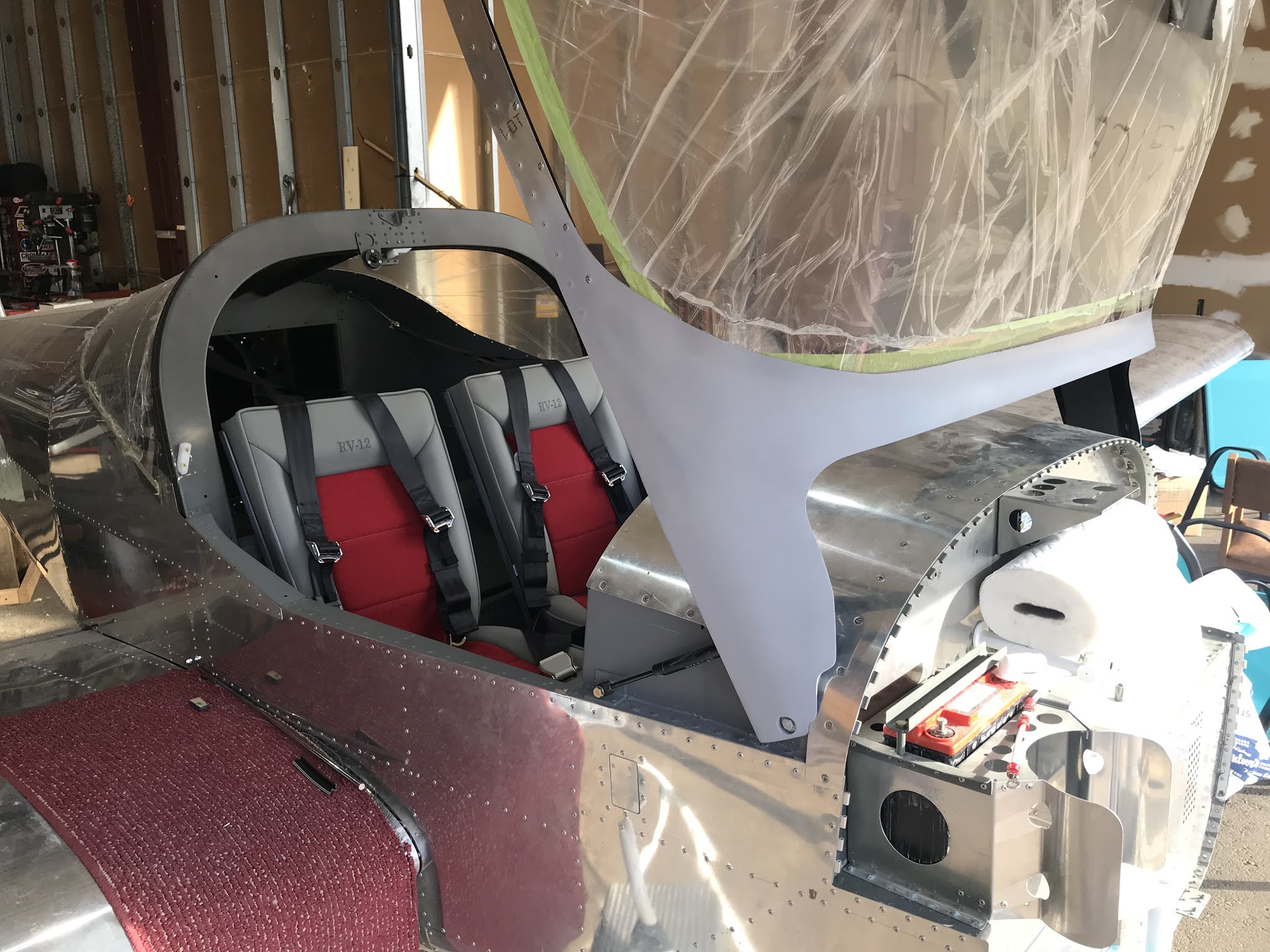
As I said before, considering what a PITA this was and how much I complained about it, I'm happy with the result.  The fit against the aluminum is good.


I installed the upholstery and five-point harnesses just to make myself feel like I'm approaching having a real airplane.  Yes, I closed the canopy, strapped in and pretended to fly.😎


A few canopy seals remain to be installed, then on to the engine!  The avionics kit has been ordered, so no more big cash outlays.

Sunday, January 10, 2021

Page 34-01: Trimming the canopy to fit the frame, then attaching the canopy to the frame (fiberglass to follow in another post)

The bare canopy frame comes with the kit, welded and ready to receive various add-on bits required for attachment of the plexiglass canopy.  The frame consists of a "front bow" and a "rear bow" connected by

some tubing of rectangular cross section, with an aluminum plate at the forward end which contains a hole for the pivot point and a second hole for attachment of the air springs.  The air springs take part of the load required to open and close the whole thing once everything is attached.  I had erroneously assumed that the canopy, like the rear window, would be essentially the right size, needing only to be correctly positioned and drilled, then riveted/screwed to the frame.  Alas, this was not the case.

After the pivot bolts are installed, the rear bow is clamped to the roll bar with spacer blocks between them, assuring the frame is positioned correctly.  At this point there should be 1/8th inch between the rectangular tubes and the fuselage rails.  Not close.  The build manual suggests taping strips of corrugated cardboard, as found in typical cardboard boxes, to the tops of the fuselage rails to provide this gap.  The problem was that when the frame was clamped into place, a compressive load was put on the cardboard, causing its thickness to be reduced.  The angle between the two welded-together pieces of rectangular tubing needed to be altered.

At this point, I made the lucky discovery that the little wooden paint mixing sticks which you're given when you buy paint at Lowe's or Home Depot are exactly 1/8th inch thick and won't be compressed by the frame.  With the pivot bolts installed and a small block of wood positioned under the weld (which can be seen in the pic as a vertical line joining two straight sections of rectangular tubing), I put my weight on the rear bow and bent the tubing at the weld.  Got it right the first time!  The frame fit like a charm, verified by little pieces of paint stirrer sticks placed all along the interface between the rectangular tubing and the fuselage rails.  Now just pop the canopy in and drill baby, drill!  Uh, no.

The canopy is supposed to have 1/8th inch clearance between the forward edge and the plane of the instrument panel and 1/8th inch clearance between the bottom edge and the canopy frame.  The build manual says to trim the aft edge to produce 1/32nd inch clearance between it and the rear window.  This is the only mention of trimming the canopy.  Clamping the canopy in place, these dimensions could not be achieved.  I wasted countless hours repositioning the canopy and re-clamping.  Couldn't be done.  I finally decided to trim the bottom edge even though no mention of this is made.  Bingo!  After many iterations of install-measure-remove-trim, it finally fit.  I was worried that having the canopy frame held to shape by the canopy would unnecessarily stress canopy, promoting cracking.  

The drilling was uneventful (this time -- see rear window post).  After clekoing the now-well-fitting canopy in place, I discovered that the canopy and frame wouldn't pivot open, requiring further trimming of the forward edge (goodbye 1/8th inch clearance!).  This doesn't matter at all since it will all be covered with the fiberglass skirt (post to follow).

Also in this section of the manual is the fabrication and installation of the canopy latch.  This involves shaping the exterior part of the handle (which I did by eye using a belt sander and Scotch-Brite wheel)


and attaching it to the shaft connected to the interior part of the handle.  The parts must be carefully aligned and drilled.  I found this difficult even though I fixtured it as best I could on the drill press, ending up with a definite angle between them.  The interior handle must be fore-and-aft in order to properly engage the latch, meaning the part out in the 150 mph slipstream (yeah, I'm an optimist) will be at a small angle of attack, causing drag.  Being an aero guy, this was unacceptable. 

My fix was to carefully elongate the hole in the shaft until alignment was perfect, fill the shaft with a mixture of epoxy and flox, and re-drill with the two parts assembled.  The screw holding all this together is tapped into the aft portion of the handle.  I coated the portion of the shaft which is inside the handle with wax so the epoxy wouldn't stick.  Everything is working well.  Opening and closing the canopy requires significant torque on the shaft.  If some play develops there over time, I'll remake the part.


Friday, December 25, 2020

Let there be light (and heat)

A southern boy tries to survive his first full winter in Colorado 

Although we've had this house in Colorado for about five years, we've mostly spent summers here with a bit of fall and spring thrown in.  This first full winter as a hangar owner quickly showed me that working on a metal airplane in really cold weather is difficult.  I used my "salamander" heater more than I should have (it says right there on the heater "Do not use in enclosed spaces") figuring that the hangar was leaky enough that I was safe breathing the products of combustion if they were somewhat diluted.  I finally bit

the bullet and had sprayed-in foam applied to the ceiling and door, and since I was already hemorrhaging money I bought and installed a Mr. Heater 80,000 BTU/hr gas heater.  To be truthful, my hangar neighbors (thanks Chad and Tom) did essentially all the work running the gas line, installing the meter and heater, running the wiring and since the were already up there, installing three more super-bright LED ceiling lights for a total of four (brand name is UFO Deformable, 7200 lumens, 6000K color temperature, $24 each on Amazon).  I believe they were concerned that a person my age shouldn't be 18 feet in the air doing that stuff -- looks like my feeble old man act worked.  I did run the conduit and wire around the walls to install 20 new electrical outlets, allowing me to make the fire inspector happier by getting rid of all the extension cords.

The picture shows the heater mounted at the ceiling, and you can also see the blown-in foam (R-28) which looks like Mammatus Clouds (my favorite kind).  The insulation on the bi-fold door looks the same but in a vertical plane.  All that's lacking is the centrally located ceiling fan, which I bought and assembled today.  This should cure the current situation where all the hot air stays at the ceiling while the air below stays about 55 F.  Even with the stratification, it's a huge improvement.  Next comes the fiberglass part of the canopy.  All the endless trimming and trial fitting of the canopy is finished (blog post to follow).

Since we're talking about the future, the engine kit has arrived!  Here's what $30,000 will get you these days:

Engine, prop, ducts, hoses, wires, everything forward of the firewall, causing my wallet to be much lighter.  The good news is that this is the next-to-last kit.  I'll order the avionics kit as soon as I settle on which bank to rob.  Using dollars per cubic meter as a metric, that box will win by a long shot.

Thursday, September 10, 2020

Page 25A: Installing the Plexiglas rear window -- an expensive tale of woe

 Note: This work occurred back in North Carolina, before the big move to Colorado, so we're a bit out of chronological order.

The kit as I ordered it came with a Lexan rear window (still in its protective plastic back in NC -- one of many parts paid for but not used) which was subject to crazing when exposed to even the smallest amount of gasoline.  The location of the fuel filler made it almost impossible to avoid this fate, so the Mothership came out with a replacement made of plexiglass (Plexiglas) which solved the problem.  Naturally, I ordered this, never missing an opportunity to spend even more money.


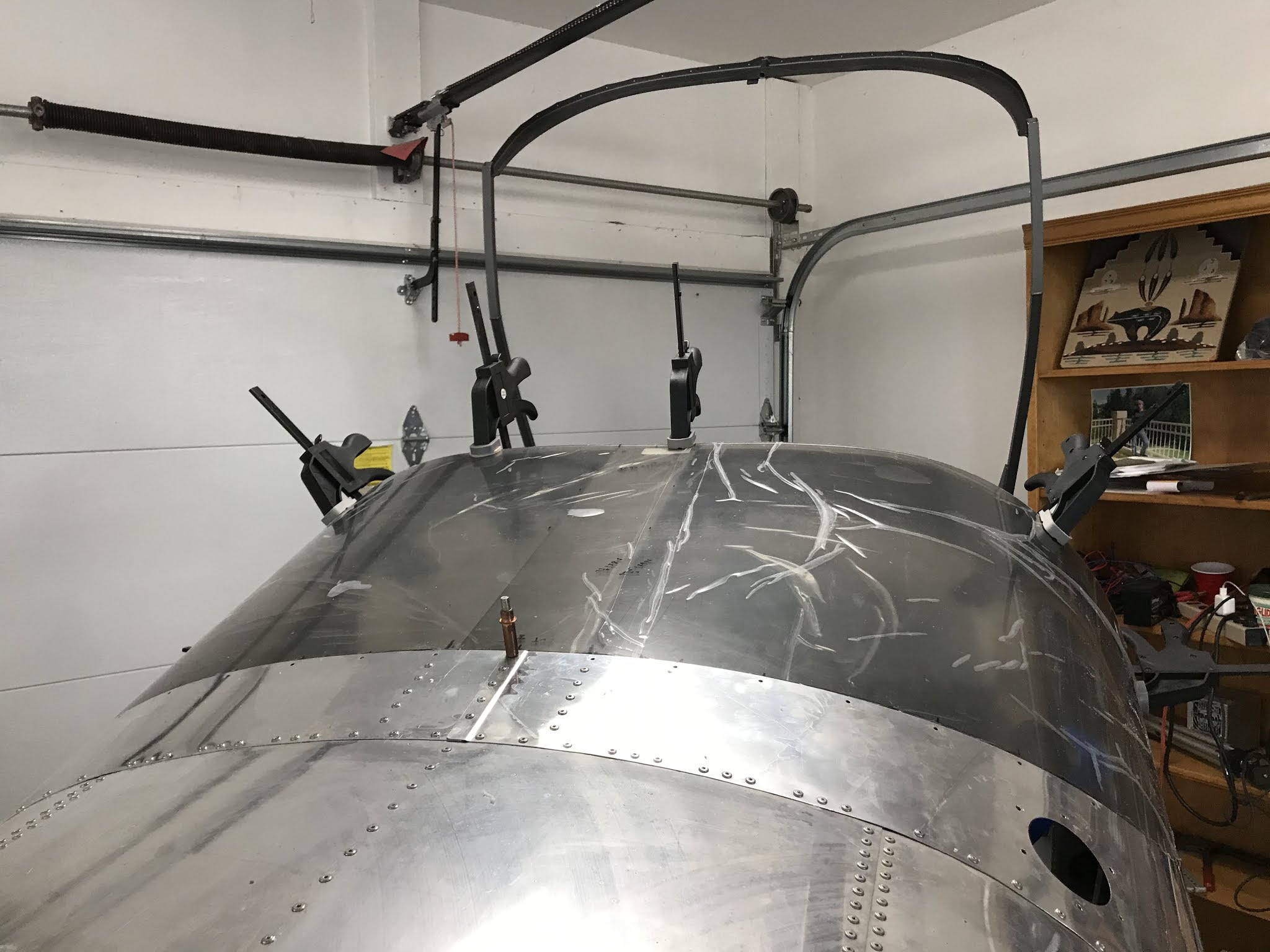
The first step in the installation called for carefully positioning the window fore and aft as well as side to side before drilling the first hole, after which further position adjustments were impossible.  I spent countless hours on this step, which makes what happened hurt even worse.  After clamping the window to the roll bar, I drilled that hole.  You can see the cleco center aft in the first two pictures.  Getting the window into this position required lots of fiddling.

The window fits over the roll bar at the forward edge but under the tail cone skin at the aft edge, meaning there's nothing to hold the Plexiglas against the inside of the aluminum skin.  To solve this problem I fabricated two flexible braces from PVC (shown in the pic).  With the plexi held firm, I felt confident in the final measurements, ensuring a good fit.  

Having to repeatedly clamp and unclamp the forward edge while repositioning the aft edge and taking measurements all around proved to be challenging.  I wasted a lot of time here.

To safely drill or cut plexi without fear of cracking, the temperature should be above 70 F, easy to do in NC in the spring.


In order to match drill the holes in the unsupported plexi along the aft and bottom edges, a helper was needed to hold a block of wood firmly against the inside of the plexi while the hole was drilled from the outside.  The Spousal Unit (a.k.a. Dr. KTH) was pressed into service for this task.  Her ghostly image can be seen through the protective plastic sheet covering covering the window.

The sequence for this drilling is specified in the build manual. Certain #30 holes are matched drilled through the aluminum skin alternating with certain #40 holes through the window and roll bar.  Clecos are inserted after drilling each hole.  Everything looked good.  Little did I know.

Then came the bad part.  Each #40 hole through the plexi and roll bar (thick aluminum) is to be enlarged to #36 with a reamer then tapped 6-32 and the appropriate screw inserted.  All holes, including the tapped ones, are to be enlarged to #27 later.  This is very unclear in the instructions and many builders didn't enlarge the tapped holes.  I started on the lower right side tapping the holes and had made it though about 75% of them when the tap shattered, cracking the window ($500).  I was using best practices, backing the tap out to clear chips every turn.  From the start it seemed that the tap was requiring an uncomfortable amount of torque going through the aluminum and plexi at the same time. If I had it to do over, I'd go straight to the #36 bit, skipping the #40, and I wouldn't tap the plexi.  All drilling of the plexi was done with bits made for this purpose and all enlarging of holes was done with a reamer or a UniBit (step drill).

After removing the window, I tapped the remaining #36 holes in the roll bar (very low torque required) and ordered a new window.  I was now faced with figuring out how to drill the roll-bar holes in the new window and make make them line up with the already-drilled-and-tapped holes.

Now extremely gun shy about working with Plexiglas, I repeated the whole process (complete with Spousal Unit inside), but eyeballed where to drill the #40 holes so that they were concentric with the existing tapped holes, not wanting to damage the existing threads.  My thinking was that enlarging the holes in the plexi later to #27 (as called for) or 5/32 (if needed) would handle any eccentricity.

The pic shows the #30 holes clecoed and the screws placed in the roll bar.  The tape around the lower and rear borders is positioned 1/32 inch (eyeballed!) from the aluminum to limit where the ProSeal goes in the final installation.  I'll wait until much later in the build to permanently attach it.  The tape on the forward edge of the canopy marks the line to which the plexi is to be trimmed, lining the leading edge up with aft edge of the forward half of the roll bar.  The trimming was done with a cabinet makers scraper.  Plexi responds well to scraping but poorly to cutting, explaining why a reamer or UniBit is ideal.  I wish UniBits came in number sizes.